Thursday, December 29, 2011

Wei Wosu (House Dedication)

On “Second Christmas” (December 26th), a couple in our village dedicated their new house. Meet Bon (pronounced "Bone") and Denisa:

Bon works for the government and Denisa owns a fabric store in the village about a 20 minute walk from our village. They worked and saved and built themselves this western style home:
Their old house is Saramaccan style, like ours, with two small rooms. They have at least four children.

True to Saramaccan tradition, the family and a few close friends are wearing the designated material that they made into clothing, which, not coincidentally matches the lime green house. Pretty awesome.
The church leaders, Basia Jonathan and Mama Nina blessing the home
The beautiful cross-stitching commonly done by Saramaccan women is used to decorate the new house
 The dedication consisted of the church leaders blessing the home, praying for the family, singing some hymns, then passing out soda, kool-aide, cake, popcorn (for the kids), and rum (for the men). It was fun. This is the first dedication that Ryan and I have seen. I think it is fairly common but houses just are not completed every day.
 Side note: our entire village was burned to the ground in the civil war in 1989. Apparently, there used to be many western style homes before then. When people came back (the few that did), most could only afford to build Saramaccan houses right away. Families will save and slowly build bigger houses but it takes years. If you walk around our village you will see plenty of partially built cement homes that the jungle has reclaimed. They are just waiting until the family has a little bit more money to buy another bag of cement or support beam.

I am glad that we decided to spend Christmas in our village this year. Although they do not do a whole lot for Christmas besides go to church (actually, kind of refreshing), it seems that many other events are packed in since family and friends who live in Paramaribo are able to come. It has been a prosperous and busy time in our usually sparse and slow paced village. 

Tuesday, December 27, 2011

Coming of Age as a Saramaccan Woman

Besides going to church on Christmas Day, we also celebrated a Saramaccan coming of age ceremony. The 23-year-old girl is from Paramaribo but her family is from our village so they brought her here, to “Saamaka”, to pass this milestone. Keep in mind, our village is in an interesting in-between place. We have a lot of connections to Paramaribo, so people come and go to the city frequently. That access brings heavy influence from the west. Plus, we are a “church village”, so the missionaries erased a lot of Saramaccan tradition, too.  It is fascinating to see which traditions are still observed and which are not. All that is to say that this coming of age ceremony does not happen often in our village. This is only the second time that I have seen it and the first that I saw from start to finish. Another contributing factor is that almost all of our young girls move to the city to continue with school once they graduate from the 6th grade. Most of them do not come back, so we really have a generation gap.

Anyways, I am friends with this girl’s family, so they invited us to come. The girl seemed very sweet. We started out at the family’s house with about 50 family members and friends. The older women undressed the girl (yes, in front of everyone), then covered her back with koosus (the material that Saramaccan women wear around their waists like skirts) that they bought for her. They gave her jewelry, as well. Her mother and aunts gave her advice- take a good man, live well with him, have children, etc. There was Saramaccan singing (specific songs for this milestone) and lots of dancing. Soon they said it was time to go.

 Once I exited the overcrowded house, I discovered a percussion band waiting outside. This seemed promising! The family carried the girl’s loot in buckets on their heads so everyone could see. One of my friends placed a small bucket on my head which I pretty successfully carried hands free (yes, it was small and light but I’m still proud)! The group set off on a kind of trick-or-treating for koosus. We would dance up to each house in the village and the girl would come to the front and dance with the owner of the house until she received a koosu. Each time she got a new koosu, it was placed somewhere on her body until she had so many layers she was just a bundle of material! And all this in the middle of the day, in the beating sun. I told her later that I don’t know how she did not pass out from the heat! We were at it for hours. At the end, they danced and sang more at the final location but Ryan and I had dropped off the parade due to the heat and exhaustion.
Dancing with my friend Madjo for a koosu
Being given a koosu by my friend's husband, Gali

Dancing with me in front of our house for her koosu
Hugging after I gave her a koosu
It was really fun. Everyone was just so enthusiastic and fun-loving. I love drums and dancing AND the look on people’s faces when they see this white girl shake her hips. ;) It’s hilarious. They are always so shocked that I have some rhythm. I am really thankful to my friends for including us. 

Tuesday, December 20, 2011

Saamaka Tou (Saramaccan Wedding)

Just as less and less Americans are getting married these days, less and less Saramaccans are getting married as well. Traditionally, the Saramaccan wedding is not legally binding but a ceremony where rum is poured out over the intertwined hands of a couple. Unfortunately, people in my village just do not do this very often any more. We have not seen it since we have been here (over a year and a half).

Another similar trend (yes, I am an anthropology nerd) is that Christians get married (legally) more often here than non-Christians. Of course, these weddings are strikingly like Western weddings, not the traditional Saramaccan ceremony. Anyways, in October, Ryan and I were fortunate enough to attend the wedding of a former language teacher for Peace Corps and a woman who works for the government, works with Peace Corps and whose family is from our village. Here is the happy couple:
That is the Presidential Palace in the background
Now, even though this is the only wedding we've been to in Suriname, it was not hard to figure out that this was VERY high class. The reception was in the National Assembly building for heavan's sake (it would be equivalent to Capitol Hill). Just to reiterate, the bride and groom both live and work in the city, not in our village. The difference between the city and the interior is like night and day, as you can deduce from the wedding party's attire. We estimated about 500 people probably came. The social event of the year!

It is very common in Saramaaka culture for people to pick one material for an event (birthdays, funerals, weddings). Then it is up to the attendees to go buy that particular material and sew it into an outfit to wear to the event. If people cannot afford to buy the material, many will not go, or they will at least try to match the colors. Alongside all the other things going on, I found time to buy the material at a store in Paramaribo. I asked a friend who works there who could sew an outfit for me. She sent me on a wild goose chase to find a seamstress. I never would have found her if Ryan had not of been with me. Of course, she did not speak Saramaccan or English. She promptly found a random, intimidating Saramaccan guy to translate from my Saramaccan to her Dutch. Talk about hilarious! There I am telling this rough looking guy to please sew me a pretty dress or skirt and blouse. He ended up being really nice. People went all out for this wedding (since it was so elaborate) and it was fun to see how creative everyone was with their outfits.


If you notice, Ryan didn't get an outfit made. In everyday life, Saramaccan women still dress traditionally while the men dress in western clothes. True to form, for this wedding in Paramaribo, the men wore slacks and button down shirts instead of making tunics out of the material like the women made outfits.

This wedding was very western and very Christian. First, they were legally married at the city hall. The small room was full and most people waited outside or just came to the reception. At the reception they exchanged rings (not a Saramaccan tradition) and said their vows. One thing I noticed that was different was that another woman and man dressed as bride and groom came down the aisle before the true bride and groom. I think it symbolizes walking in the path of a successful marriage. There was a lot of entertainment from the diverse cultures in Suriname: traditional Saramaccan dancers, Javanese musical performers and Chinese dancers.

Weddings are one of the best windows into a culture. I hope we are able to attend another before our time here ends. I would love to see a traditional Saramaccan wedding where they pour out rum.

Click here to see the rest of the wedding pictures.

Friday, December 2, 2011

Boys, boys, boys!

Two of my very best friends have kids- boys to be precise. Alysha's ADORABLE son Jesiah is 16 months already. Although we just met a week ago (she had him shortly after I arrived in Suriname), I am happy to report that we are fast friends. He took a liking to his Auntie Lindsay right away. :) We went on a little Disneyland adventure. He was so good! That kid is so easy going and SMART!
Click here to see all of our Disneyland pictures. We had a blast!
I am thrilled to report that I was able to see Valoria pregnant (maternity pics by Claire Wolf here) AND meet her beautiful son Cassius Nasir Jones on this trip. Cash was born on November 29th weighing in at 9lbs 9.5 ounces. Mama and baby are doing well! Congratulations Valoria and Brian!


P.s. I know it has been awhile since I've blogged. I have lots to catch up on- my first Saramaccan wedding and my whole trip to America plus lots more gorgeous babies! Stay tuned.


Tuesday, October 4, 2011

HIV/AIDS Education Project

 
As I mentioned in an earlier post, I just completed my first major HIV/AIDS Education Project in my village. I worked with two community partners- one of my policlinic nurses (Linda) and the head of the local women's organization (Helga). They were both phenomenal. Though they were my official partners, the 5 week (once a week) educational classes would not have been the success that they were without the group effort of several of my friends and neighbors. I am truly blessed to have such strong, intelligent women in my village.
Left: Helga Right: Linda
So, Linda, Helga and I gave the same class to two different groups of women every Sunday and Monday for four weeks. The majority of the women were from my village but on Mondays women from two neighboring villages (who currently do not have Peace Corps volunteers) traveled by boat to attend the trainings.

Many people have asked me if HIV/AIDS is a huge problem in Suriname. That question is difficult to answer as accurate, up-to-date data is not readily available. HIV/AIDS has not reached the epidemic status here as it has, for example, in many parts of Africa, however, there are many factors that threaten an epidemic in the near future. In other words, NOW is the time to fight this disease with awareness, education and understanding to hopefully prevent an exponential increase in transmission. Some of these factors include (and this is speaking from a Saramaccan viewpoint, not Suriname as a whole): co-wives being socially acceptable, transient lifestyle of the male population (looking for jobs), poor health education, prostitution in the gold bush, poor condom accessibility, poor HIV test accessibility and immense social stigma.
We gave every woman a teaching booklet so they can spread their knowledge of HIV/AIDS
During the first four weeks we covered how HIV is transmitted, addressed local myths and fears, talked about where villagers can get free condoms and free HIV tests, how to properly use condoms and what to do if someone is HIV positive (medication, lifestyle, first steps, etc). In addition, one of my Saramaccan friends (we'll call her Susan) was brave enough to travel to my village and share her personal story of contradicting HIV and how she lives with it. I have to admit that I was nervous for her to come. I was worried about the ugly face of stigma and I did not want anyone to offend Susan. I was relieved and heartened to discover that the women of my villager really stepped up and, although I could tell many were frightened, they embraced Susan and openly admired her strength and courage. I think this was the most powerful part of my classes and I am indebted to Susan who just cannot help but make everyone love her. After Susan told her story, we pushed deeper into fighting discrimination against people with HIV/AIDS and I could see the change of attitudes right before my eyes.

On the fifth Sunday, men, women and older children were invited to an HIV/AIDS Awareness Day put on by selected women from my class. It was a hectic day but I was pleasantly impressed by the women I had been meeting with one on one (outside of the normal trainings) to give the lesson. They remembered everything and did an amazing job! Besides the total of 54 women who attended the 4 classes, over 100 people came to the Awareness Day.
Helga practicing her part (how HIV IS transmitted)

Melo giving her part of the training (how HIV is NOT transmitted)


Impromptu dancing and singing afterwards
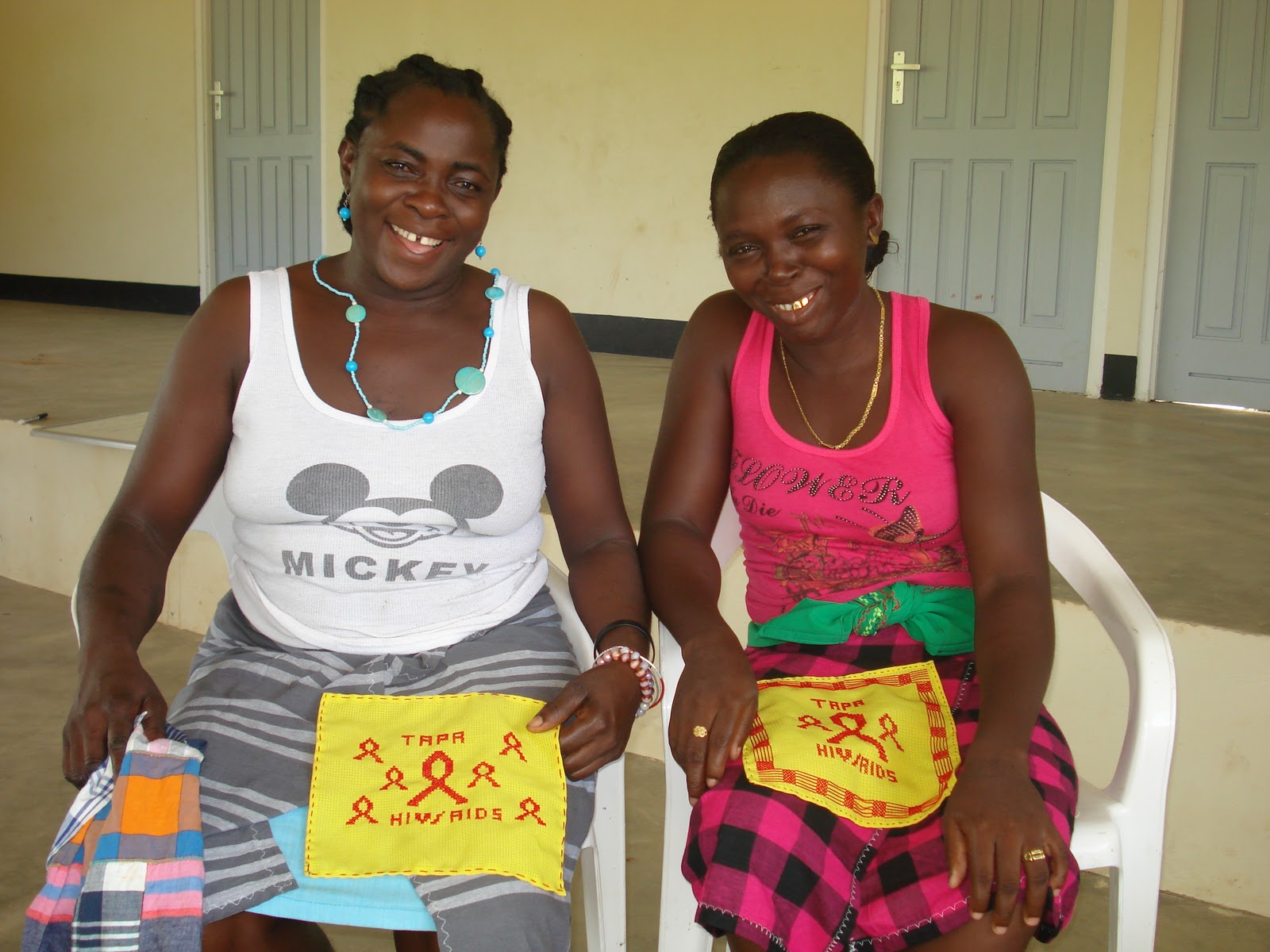
The women in the class each cross-stitched a square for our HIV Awareness Quilt that will be hung at the policlinic in my village. Cross-stitching is a big part of Saramaccan culture and served as a time of discussion among the women while they sewed during the week. Our hope is that it will be a conversation starter at the policlinic and help people feel more comfortable discussing HIV/AIDS. My fellow Peace Corps volunteers Shannon and Amber, who also live in Saramaccan villages, came up with the idea to incorporate cross-stitching into an HIV Awareness activity. Encouraged by the success in their villages, I decided to take the same concept and create an extended curriculum. Thanks Shannon and Amber!
All of the participating women on the Awareness Day with our final HIV Quilt
Helga and Diana with their finished cross-stitched squares
My square! It means "How will you stop HIV?"
I have led HIV/AIDS trainings at Camp Glows, helped other volunteers with their HIV/AIDS projects and had many informal discussions but this was my first official HIV/AIDS project in my village that I alone coordinated. I am really excited to have this under my belt and happy to report that I sincerely think (and pray) that the difference in these people's knowledge of HIV/AIDS will help fight the spread of the disease in Suriname. I gained a lot of hands on experience and look forward to applying it to my next projects.

A special thanks to my hubby for photographically documenting this project for me.

Monday, August 22, 2011

Busy, busy, busy


A lot is going on, as usual. The mother of one of our good friends in the village recently passed away so we’ve been busy with funeral ceremonies. This is the first time that I have felt comfortable bringing my camera to these events, so I hope you all find them interesting.

In the middle of all that, I traveled to the city to buy supplies for a five week HIV/AIDS education class with the women in my village and two neighboring villages. We had the first class already and it went well! Expect pictures from that project later. I appreciate prayers and good thoughts for success over the next month!

Straight back from the city, we’ve been at end-of-the-school year events as the Suriname summer vacation is starting (during their big dry season). This means no more English lessons at the school for the next 2 months. I am going to take this time to improve the English/Saramaccan workbook that a previous volunteer created before we start classes with the new 5th and 6th graders in October.

Two good friends and I are also starting to plan the next CAMP GLOW on our river. CAMP GLOW is a life skills/empowerment camp for girls ages 12-15. I have helped with two already but will be co-leading this one. Wish me luck!

So, here is my picture update. Enjoy!

Wednesday, August 17, 2011

I have a porch- finally!!!


Our porch is finished!! Our friend Mark came down (who has a degree in Construction Management) and he and Ryan put their heads together and figured out how to complete our porch. It is AWESOME! First of all, it increases the size of our house by 50% and now we have a place to sit that is out of the rain but out of our house which gets very hot from the sun and from cooking anything. They built a bench so we can seat more people and we can also tie two hammocks! I LOVE it. It makes our house so much more comfortable and easier to have people over.

Here is a picture of our house as we found it one year ago:

And here is a picture of our house now:

Crazy, huh?! Thanks my hubby and Mark! I told them this was practice for the porch they’ll build me in America. :) Click here for more pictures of their hard labor.